What is Anthropology Anyway?
Although I’m an academic, part of my goal with this blog is to present ideas in a non-academic, non-jargony way. Us anthropologists can talk a lot about the things we care about, but sometimes we can get caught up in our passion for the field and forget to share our passion in a way that others would understand. Remember, Annthropologically Rooted is a safe and shared space, so if I ever present or explain concepts and ideas that don’t quite make sense, or you’d like to learn more about, please leave comments and feedback! After reading this piece, I hope you learn a little (more) about anthropology and understand why I love it so much. With that being said, let’s begin!
It’s kind of crazy I’m writing about what anthropology is, because this is such a hard question to answer when I’m asked. Of course, I know what anthropology is, but it encompasses so much that it’s hard to give a definition that truly does the field justice. In plain terms, anthropology is the study of humans and their cultures. Anthropology uses a very holistic, or all-encompassing, approach to understand humans and their ways of being. This means that anthropologists look at the whole picture when researching a culture or an aspect of life. Understanding the essence of human beings means we also need to understand beliefs and values, religion, government, meaning systems, social norms, and so much more. Anthropology means considering the cultural along with the social, political, economic, environmental, and historical.
I can’t tell you how many times I’ve told someone I’m an anthropologist and they respond with, “So like, you learn about dinosaurs and dig up bones?”, and trust me, most of the time they aren’t being funny. But kudos to those people because archaeology is a subfield of anthropology, and that does involve digs and artifacts, but all anthropologists are not archaeologists; I’m not studying dinosaurs, and I’m definitely not Indiana Jones! Another common response is, “Oh, that’s like sociology?”, and yes, anthropology and sociology are very similar, consider them to be sister subjects. However, please refer to one of my favorite memes below to recognize that anthropology and sociology are in fact different.
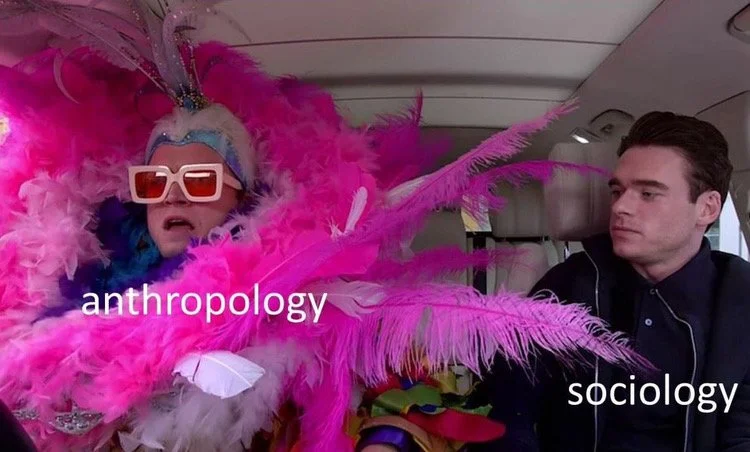
The academic run-down of anthropology:
A textbook explanation of anthropology will tell you that there are four subfields: cultural, biological/physical, archaeology, and linguistic. The four subfields have their own specific distinctions and focus, but all are still intertwined and connected. For example, archaeologists need to understand past cultures to analyze artifacts, and they also need to consider human physiology and perhaps diet to draw concrete conclusions about the past. Linguistic anthropologists study communication, but without understanding how cultures make meaning, it is hard to analyze and understand language. Biological anthropologists need the use of the other three subfields when analyzing human evolution to better understand past and present behavior. In summary, although there are four subfields of anthropology, they are all interconnected and important in understanding the overall study of humans and their cultures.
Aside from these four main subfields, there are also specializations within the subfields. Some of these specializations are psychological anthropology, cognitive anthropology, economic anthropology, and my favorite, medical anthropology. There are also even more topical interest groups within the anthropology community that help organize specific topics of focus or research interests. Some examples include anthropology of religion, environmental anthropology, and anthropology of policy. Like I said, medical anthropology is my favorite, hence why I am currently in a medical anthropology PhD program. Medical anthropologists study how social, cultural, biological, and political factors shape health and well-being among human cultures. Medical anthropology considers a biocultural perspective that moves beyond the biological or physiological presentations of health and well-being to consider how groups experience health in diverse ways. In a forthcoming Issue, you will learn more about how I arrived at medical anthropology and the journey I took to determine my passion and interests, and I will dive deeper into what medical anthropology is and how it can be used.
Now that you know about anthropology’s subfields and topics of focus, you might be wondering how exactly these topics are studied. Well, anthropologists are known for their methods. Our main method of ethnography is a qualitative method that involves (often) long-term fieldwork to immerse ourselves in the everyday lives of the groups we are studying. Ethnography entails many methods, such as participant observation, interviewing, and taking field notes. In order to best understand a culture’s behavior and social life, you need to step into their social world, and this is the main goal of ethnography. Anthropologists will often live with and among their participants and follow them throughout their daily lives, participating in activities while also observing what takes place. You can think of participant observation and the practice of ethnography as “living like a local”. Anthropologists might leave their home to study groups in other countries, and although they are an outsider, they work to build trust and rapport with their participants through ethnography to better understand their daily lives and practices. Even anthropologists who study their own home or culture, such as myself who works in the United States, it is still important to “live like a local” and drop any assumptions or biases you might have about your participants.
The real-world run down of anthropology:
So, now that you have a very basic textbook overview of anthropology, let’s talk reality. I told you what anthropology is and the methods anthropologists use, but what does this look like in everyday practice? What is the point of studying and understanding humans and their cultures? I might be a tad bit biased, but I think anthropology is extremely important, useful, and necessary for our everyday lives. Anthropological research can be used to solve real-world problems concerning things like human rights, public health, and the environment. I’ve read the work of many anthropologists and have interacted with many professors and scholars throughout my education, and they all are using their research and work to contribute to the world in meaningful ways. Anthropological research can be used to inform policy and advocate for change on behalf of your participants. Research can even be used to inform legislation and change or introduce laws that protect the health and well-being of certain groups. Anthropological research can be used to draw attention to important issues (in a global context) that the general public might not know about. I even know anthropologists who have used their research and skills to better the user experience by evaluating products or services and developing suggestions for change or improvement.
Now, I would not be a good anthropologist if I gave you the “pretty” version of what anthropology is. We cannot begin to think about anthropology and its importance, especially in today’s world, without acknowledging the history of the field and how far we have come. Like many things in our society, anthropology has a history rooted in colonialism. Anthropology emerged as a field largely interested in studying “primitive”, non-white, “others”. Anthropological work and thought rested on many false assumptions and stereotypes about the white race and incorrect beliefs of its superiority. The method of ethnography, studying the “others” and “living like a local” grew out of the interest of anthropologists to understand what non-white life was like in different parts of the world. Studying colonized groups and groups often untouched by the outside world introduced power imbalances and unethical research practices that anthropologists still work to undo and make right today. There have been widespread (and successful) calls to decolonize the field of anthropology, however, we cannot forget the past and we can never undo what has already been done, what has built our field, and what has been imbedded by much of our research. Like I said, I wouldn’t be doing my part if I only gave you the “pretty” version of anthropology. Despite this, as I said earlier, there are many, many anthropologists working today that are ethical, humane, and genuinely good people trying to do good work.
The field of anthropology has often paralleled important shifts and movements throughout history, within the United States and globally. Many anthropologists study topics or groups that are underrepresented, marginalized, historically oppressed, and socially vulnerable. By calling attention to these topics and groups, and also studying these topics and groups with care, anthropologists are doing their part to work towards decolonization and overall social justice within our world. Not only do anthropologists study these topics and groups, but many also identify as members, advocates, and allies of oppressed and marginalized groups. Being an anthropologist and doing this work is personal for a lot of us; working to decolonize the field and uphold social justice isn’t just a professional or academic tactic to make the field look good and undo our problematic history. Many anthropologists employ methods that privilege their participants, making sure their voices and experiences are heard and valued. Some anthropologists even use collaborative research methods where participants are included in the overall research process, such as developing research questions and selecting appropriate research methods.
So, with that being said, when you think about anthropology in the real world, you cannot forget the history of anthropology and how it still affects our practice today. You also cannot ignore what is taking place in our world today, as so many different groups face oppression and injustice. Understanding anthropology in the real world, in today’s world, means having a diverse but critical perspective that values and prioritizes all the groups historically known as the “other” and as “less than”. It means constantly thinking about decolonization and social justice but also understanding that anthropologists are not perfect and not all anthropologists are inherently good people that work to advocate for others. Yes, it is entirely possible that some anthropologists are just in it for themselves (which, considering the scrutiny of our field today, the widespread misunderstanding of what we do, and the lack of high paying “anthropologist” jobs, may be hard to believe) but I truly believe that many anthropologists are genuinely just trying to do good. We want more people to understand what we do and why it’s important, and we want more people to (as my wonderful advisor says) wear their anthropology hats proudly. Anthropology has its specific specializations and topics of focus, sometimes hyper-specific and often considered irrelevant to many in the world, but anthropology in general is great for developing skills like problem solving, critical thinking, and communication. Anthropology skills can ultimately be transferred to any career path, and the research we conduct has the ability to be useful in so many aspects and domains of global life.
What does any of this mean for us?
At this point, I’m not sure if anything I said makes sense or has actually done the field of anthropology justice (LOL). I think what I’m trying to get across is that anthropology is extremely important in the real world and especially in today’s world as we navigate unprecedented change and uncertainty. I’ve been learning about anthropology for more than 10 years now, so the importance is very clear to me. Living through historical moments, such as the COVID-19 pandemic, made it even more clear why anthropology is important. From the time I first learned about anthropology in high school to now, being just one year away from having a PhD in anthropology, so much has happened in the real world, and I viewed it all through an anthropological lens while wearing my anthropology hat proudly. My hope is that this blog piece, and Annthropologically Rooted overall, can help you view the world through an anthropological lens. I hope you can begin to understand why anthropology is important and how it might be relevant or useful in your own life.
After reading, if you still have questions or want to learn more, feel free to leave a comment or use the “Contact” feature to reach out! I’m always happy to talk anthropology, share my insights and knowledge, and discuss the different things taking place throughout our world. My goal is not to change your viewpoint or force you to think a certain way, but instead, to encourage you to expand your thinking to view more things, regardless of your beliefs, through an anthropological lens. With that, I’ll conclude this piece and hope that I’ve left you with some new knowledge and maybe even some new questions. As you move on and go along throughout your daily life, think about what anthropology means to you, how you see it in your everyday life, and how you might incorporate anthropological thinking and values in your own way. The last piece in this issue offers a beginner’s toolkit with some fun ways to start your own anthropology journey and think more about its importance. Overall, I hope this first Issue was a great introduction to Annthropologically Rooted, and I hope you come back in March for Issue 2!